Listening, analysis and sound teaching
Soundscape Annotation Atelier
First-hand soundscape annotation with a controlled vocabulary of 128 terms across 8 taxonomies, from Schaeffer to Wishart. Software artefact of the Soundscape Annotation working paper (Zenodo DOI).
- Author's contribution
- Concept of the method and of the controlled vocabulary, software design and development, author of the working paper.
- Context
- Teaching, Accademia di Belle Arti di Macerata
- Teaching, Conservatorio G.B. Martini di Bologna
- Status
- In use
- Data
- Audio, annotations and projects stay in the browser (IndexedDB). The JSON, PDF and IIIF exports are files saved by the annotator.
Publication
Soundscape Annotation: workflow iterativo, stratificazione interpretativa e calibrazione di una skill di analisi audio in didattica AFAM
Zenodo, working paper, CC BY 4.0
DOI 10.5281/zenodo.20282495Ecosystem and applied cases
The project
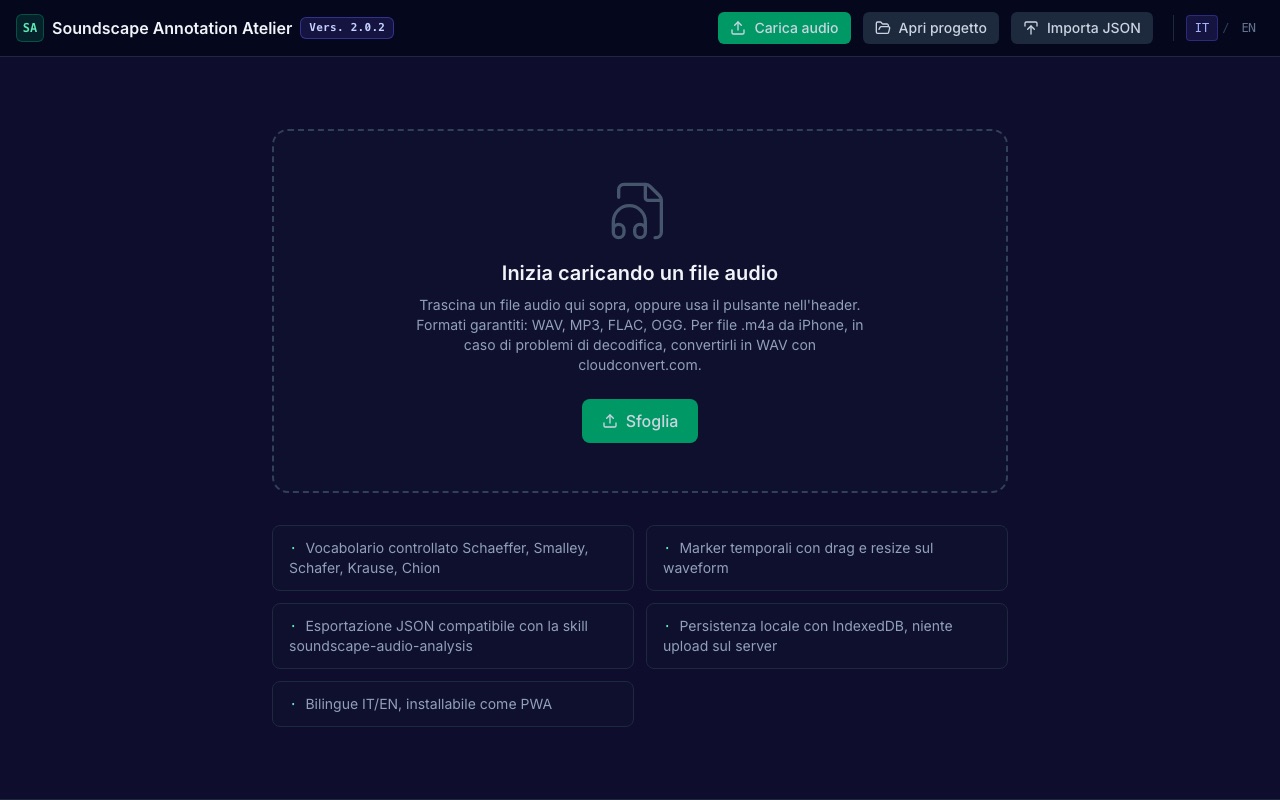
A Progressive Web App for the first-hand annotation of soundscapes, field recordings and electroacoustic composition, the software artefact of the Soundscape Annotation working paper (Zenodo, CC BY 4.0, DOI 10.5281/zenodo.20282495) and companion of the open source soundscape-audio-analysis toolkit. Load an audio file (WAV, MP3, FLAC, OGG, M4A), view it as an interactive waveform with spectrogram, and annotate time markers with a controlled vocabulary of 128 terms across eight referenced taxonomies, Schaeffer (typo-morphology), Smalley (spectromorphology), Schafer (soundscape), Krause (acoustic niche), Chion (listening modes), plus Truax, Westerkamp and Wishart.
A synchronic layers panel, inspired by the formal analysis of Aural Sonology (Thoresen), lets you stratify annotations and promote the simultaneous sources suggested by the toolkit, beyond a single dominant label. A notation lane with spectromorphological signs and a form-building lane allow drawing signs along the time axis, linking elements with typed relations (transformation, repetition, contrast) and visualising the phases of the energetic form, also by promoting the toolkit's proposals.
The output is a deterministic, re-importable JSON consumed by the toolkit pipeline, with typographic PDF export of the annotation sheet and IIIF Presentation 3 export, where each annotation becomes a Web Annotation with a temporal fragment on the audio canvas and a link to the SKOS vocabulary published by the Atelier. No server upload, IndexedDB persistence, bilingual IT/EN. Adopted in the author's courses at the Academy of Fine Arts of Macerata, where it supported the validation case study of the paper, and at the G.B. Martini Conservatory of Bologna in the Ear Training for Sound Technique course.
Features
- Controlled vocabulary of 128 terms
- 8 taxonomies (Schaeffer, Smalley, Schafer, Krause, Chion, Truax, Westerkamp, Wishart)
- Interactive waveform and spectrogram
- Synchronic layers (Aural Sonology, Thoresen) with toolkit-suggested sources
- Spectromorphological notation, form-building relations and form phases on the timeline
- Deterministic JSON + PDF export
- IIIF Presentation 3 export with SKOS vocabulary
- Synced with the soundscape-audio-analysis vocabulary
- Bilingual IT/EN, IndexedDB persistence
Characteristics
- Audio
- Offline
- Export
Tech stack
- React
- TypeScript
- Vite
- Tailwind CSS
- Wavesurfer.js
- i18next
- jsPDF
- IndexedDB
- PWA
Collaborations and research
If this work is relevant to your field, profile and contacts are on the main site.
Contact on francescomariano.art