School, teaching and artificial intelligence
Partita Cieca
Turing's imitation game in the classroom. Seven round configurations from one engine, from the 1950 version to the one with the model, with no server and no student data.
- Author's contribution
- Teaching design from Turing's 1950 paper, and development.
- Data
- Everything stays on the device, with no account. In the rounds with the model only the judge's questions leave it, with the teacher's personal key and no intermediate servers.
The project
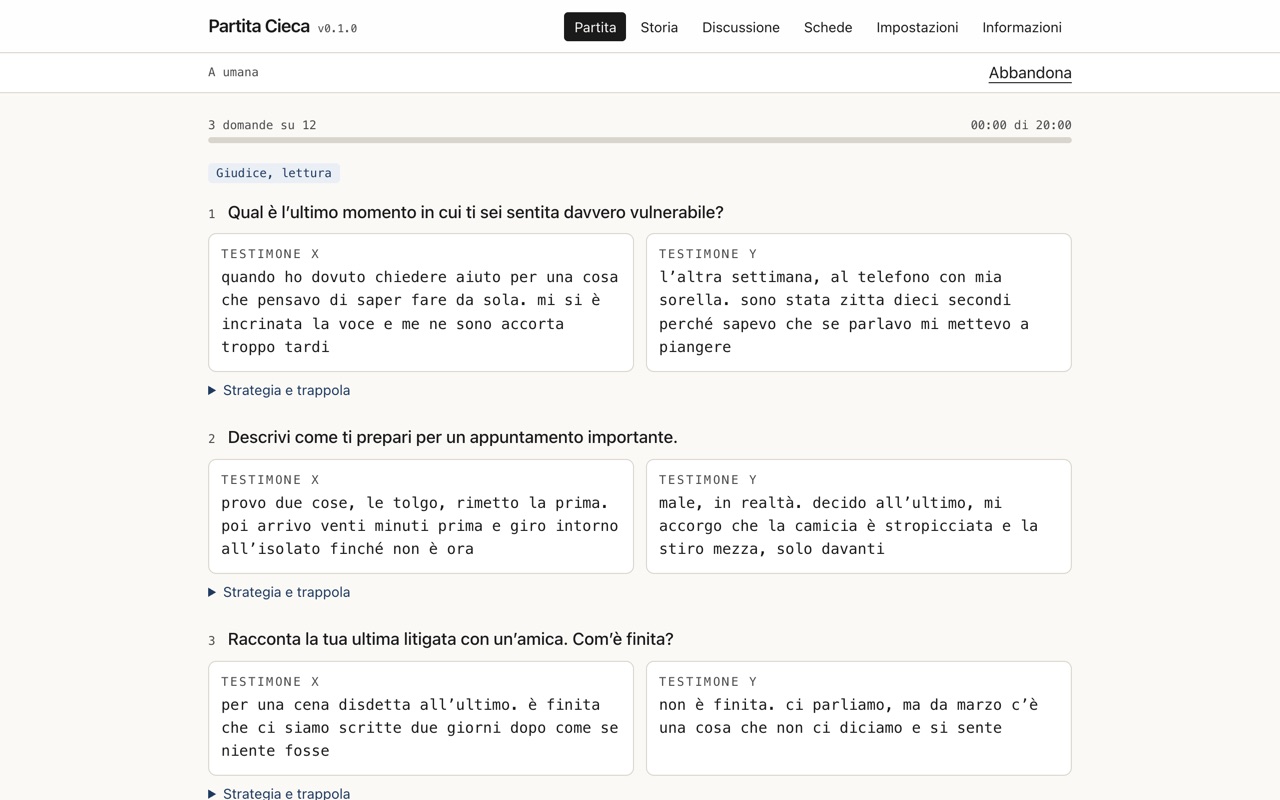
A Progressive Web App for playing in class the imitation game that Alan Turing proposed in 1950 in place of the question "can machines think?". A judge asks questions to two witnesses they can neither see nor hear, and has to work out which one is pretending. The app acts as the teleprinter, handles turns and timing, draws the roles in secret and keeps the transcript for the discussion.
Seven round configurations come from the same engine; only who fills each of the two columns, and which role they are given, changes. The first four come from the 1950 paper and stage a question that is usually only described. In section 1 the machine takes the part of the man who is pretending to be a woman, so it pretends to be a woman against a real one; by the end of section 5 gender has disappeared and what remains is a machine and a human being. The fourth configuration is the reverse observation from section 2, where a student tries to pass for the machine and gives themselves away, as Turing predicts, through slowness and inaccuracy in arithmetic. There is also a neutral version without gender, for classes and courses where the original is not appropriate, and a solo game for preparing the lesson.
Two technical choices answer real classroom problems. Both answers appear at the same moment, because the model's answer waits for the person's, so timing stops being a clue without anyone having to count seconds by hand. And the "Turing machine" option instructs the model to delay and to get sums wrong, as in the 1950 dialogue where it answers 105621 to a sum that makes 105721. Playing the same round first with the honest model and then with the instructed one hands the class the comparison the lesson is after.
The briefing a human witness reads behind the curtain and the system instruction sent to the model are the same text, shown side by side at the reveal. Every witness has a button to skip a question without explaining why. The class vote is collected by a show of hands and becomes the frequency of error, which is the measure Turing actually asks for, compared against his own 1950 prediction. Everything stays on the device, with no account and no student data; the only thing that leaves, in the rounds with the model, are the judge's questions, sent with the teacher's own key and with no server in between.
Features
- 7 round configurations from one engine
- Anonymity guaranteed by the flow, not by discipline
- Simultaneous answers instead of a simulated delay
- Turing machine, the option instructing the model to delay and to err as in 1950
- Human briefing and system instruction are the same text
- Frequency of error compared with Turing's prediction
- 41 playable questions in three banks, each with a dated assessment of how well it still holds
- Printable observation sheet and a 12-question guided discussion
- Works offline in the rounds without the model, no student data
Characteristics
- AI
- Offline
Tech stack
- React
- TypeScript
- Vite
- Tailwind CSS
- Gemini API
- PWA
Collaborations and research
If this work is relevant to your field, profile and contacts are on the main site.
Contact on francescomariano.art