School, teaching and artificial intelligence
Imparo IA
A music and artificial intelligence lab for primary and lower secondary school. Six stations with models running in the browser, from listening to a place to a melody continued by the machine.
- Author's contribution
- Concept, instructional design, field recordings for the sound bank and development.
- Status
- In use
- Data
- The models run inside the browser and recordings stay on the device, with no accounts. The tutor is reserved for the teacher and works with a key of their own, which stays in their browser.
The project
A Progressive Web App for teaching music with artificial intelligence in primary and lower secondary school, and in part in upper secondary school. The models run inside the browser on the classroom device, with no accounts and nothing leaving the room, and after the first load every station also works without a connection. It is the pupils' lab of the same line whose teacher course is Aula IA.
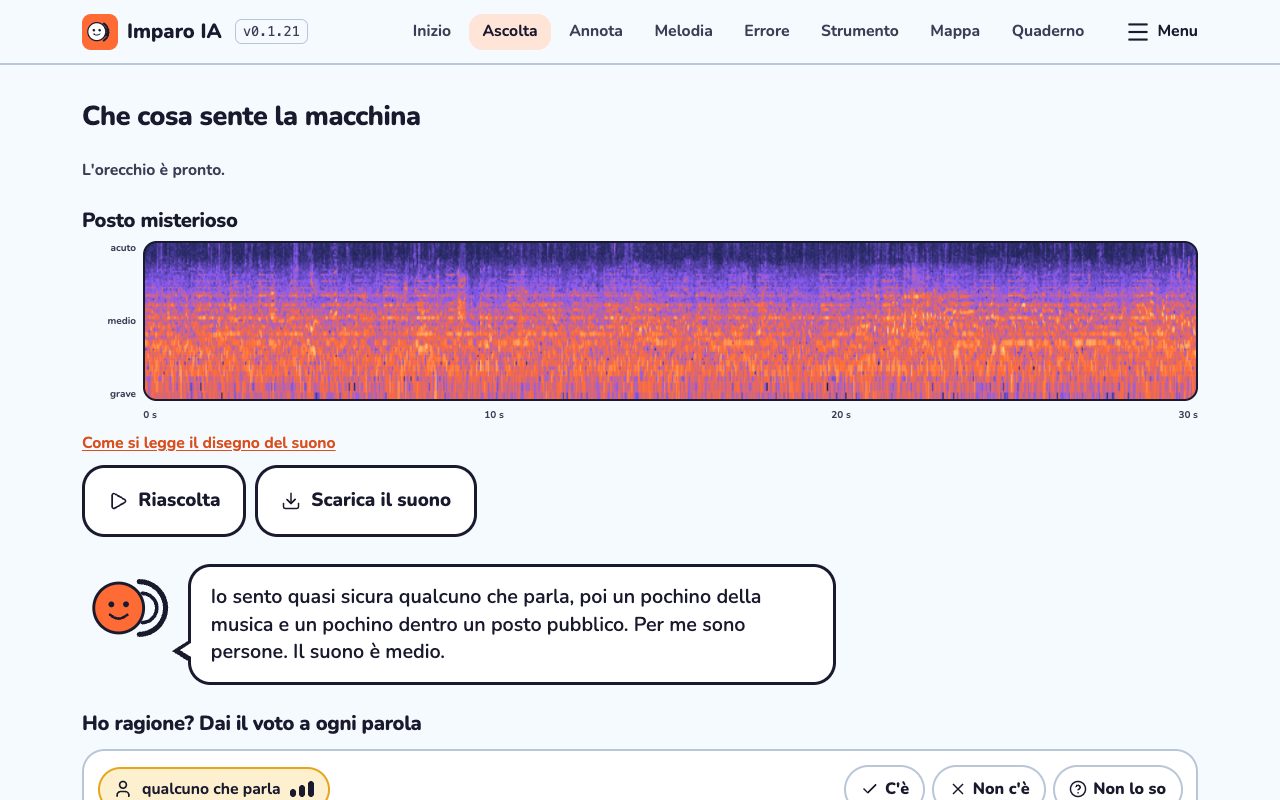
Six stations, each with a question of its own. The sound map has the class listen to one minute of the place they are in and mark every sound on a radial map, by distance and direction, with Schafer's questions and Krause's families. What the machine hears records ten seconds, shows the words the model recognises and how confident it is, and the pupils grade every word. Annotate in chunks has a soundscape annotated chunk by chunk and compares the class reading with the model's, with an export towards Soundscape Annotation Atelier. Continue the melody has an opening written note by note, with the note values and rests the class chooses, and the model carries it on with three degrees of freedom, all written on the staff and downloadable as MusicXML and MIDI. Where is the mistake puts two versions next to the real sound, only one of them manipulated, to train informed suspicion. Guess the instrument pits the ears of the class against the machine's on orchestra and band timbres.
The sound bank holds 87 clips, five recordings by the author and 82 CC0 samples, and the corpus of the mistake game is built in house, with a single declared manipulation per sound and the distance from the real sound measured. The notebook keeps what the class produces on the device, maps, sheets, scores and games, and exports it. The teacher page states what each station is for, what to observe and which questions to ask, and prepares the lesson for offline use by downloading the needed files in advance.
The texts come in two registers, one for primary and one for lower secondary school, pupils are addressed informally and the machine's ear speaks in the first person. The language-model tutor is reserved for the teacher and works with a personal key, everything else runs locally.
Features
- Six stations, from listening to a place to a melody continued by the model
- Models in the browser, YAMNet for sounds and MusicRNN for melody
- Radial listening map with Schafer's questions and Krause's families
- Chunk annotation compared with the machine's reading
- Real staff notation, with MusicXML and MIDI export
- Sound bank of 87 clips, five recordings by the author and 82 CC0 samples
- Two text registers, primary and lower secondary school
- Notebook on the device, with no accounts
- Teacher page with the purpose of every station and the questions to ask
- Lesson prepared for offline use, with files downloaded in advance
- Tutor reserved for the teacher, with a personal key
Characteristics
- AI
- Audio
- Offline
- Export
Tech stack
- React 19
- TypeScript
- Vite
- Tailwind CSS
- TensorFlow.js (YAMNet)
- Magenta MusicRNN
- abcjs
- IndexedDB
- PWA
Collaborations and research
If this work is relevant to your field, profile and contacts are on the main site.
Contact on francescomariano.art