School, teaching and artificial intelligence
ELIZA Lab
The 1966 chatbot rebuilt in Italian for the classroom. Students talk to ELIZA and, above all, program it, rule by rule, then trade their bots as files.
- Author's contribution
- Italian reconstruction of Weizenbaum's program, teaching design and development.
- Data
- Everything runs on the device, with no account and no data sent anywhere.
The project
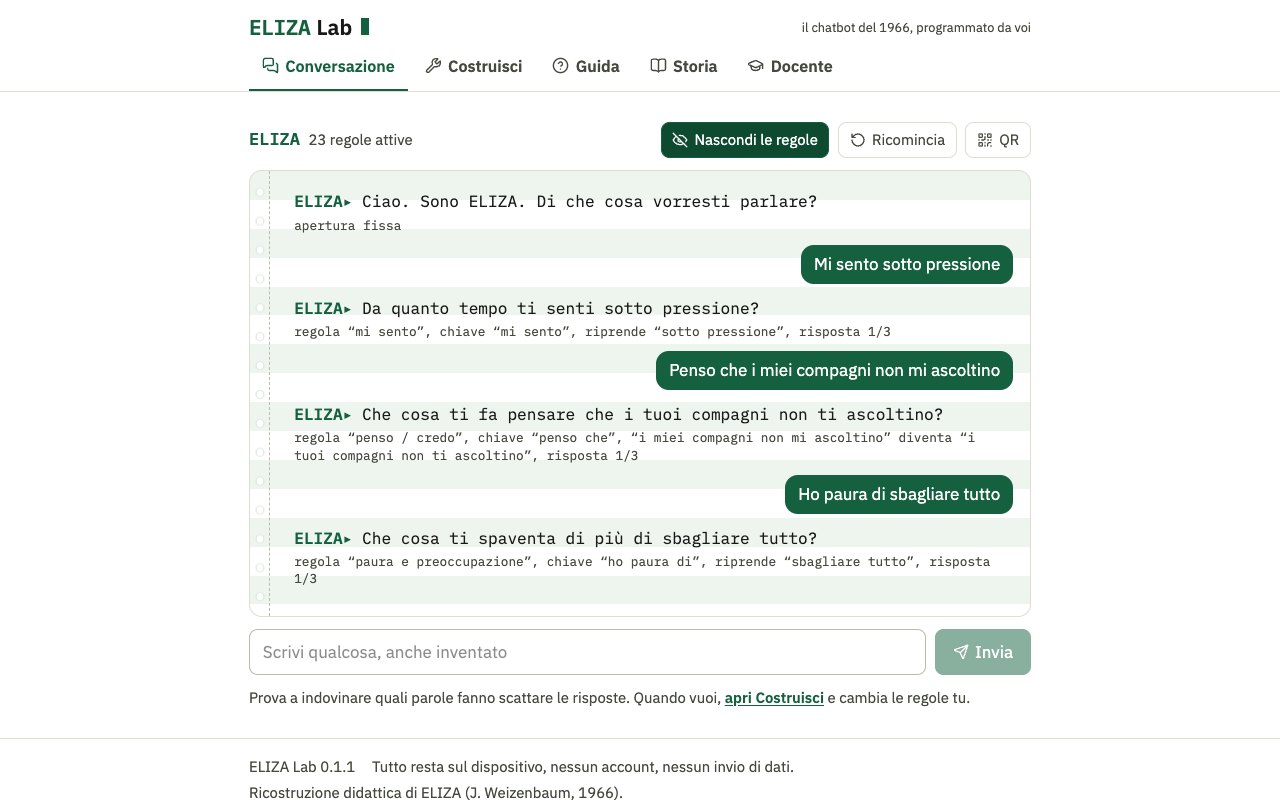
An educational Progressive Web App that rebuilds ELIZA, Joseph Weizenbaum's 1966 program, in Italian and hands it to the classroom as an object to take apart. The conversation prints on green-bar continuous-form paper, as on the terminals of the era, replies typed out letter by letter under a block cursor, and a "behind the scenes" panel declares, for every reply, the rule that fired, the keyword, the reflected pronouns and which of the rotating responses came out. Twenty-three starting rules, no understanding, no memory.
The heart is not the chat, though, it is the editor. Every rule, the starting set included, is editable data, each one has a name, several keywords, several rotating responses and a position in the list that acts as priority, the first rule that fires answers. Inside responses, $1 picks up what follows the keyword with pronouns mirrored, and $parola repeats the keyword itself. A live test bench shows which rule fires on any sentence without touching the conversation. Students name their bot, write its opening line and fallback phrases, and trade their work as JSON files the teacher collects and recombines, bot by bot or into a whole-class bot.
Everything runs on the device, with no accounts and no data sent anywhere, and it works offline after the first load. A full guide explains every piece, from reading the behind-the-scenes line to the reasons a rule may fail to fire, one page tells the story of 1966 and of the ELIZA effect with sources and two period films, and a teacher page offers "An hour with ELIZA", a ready five-phase activity that walks the class from anthropomorphism to its undoing, because whoever wrote the rule can no longer credit it with understanding.
Features
- ELIZA chat in Italian with 23 starting rules
- Replies typed one letter at a time, like a teleprinter
- Behind the scenes, rule, keyword and reflections declared for every reply
- Full editor, the starting rules are editable too
- Visible priority, list order decides which rule answers
- $1 (mirrored pronouns) and $parola placeholders in responses
- Live test bench that never touches the conversation
- JSON export and import for classroom exchange
- Built-in complete guide with a troubleshooting section
- Teacher page with a ready five-phase activity
- No accounts, no data leaves the device, offline-ready
Characteristics
- AI
- Offline
- Export
Tech stack
- React 19
- TypeScript
- Vite
- Tailwind CSS
- PWA
Collaborations and research
If this work is relevant to your field, profile and contacts are on the main site.
Contact on francescomariano.art